

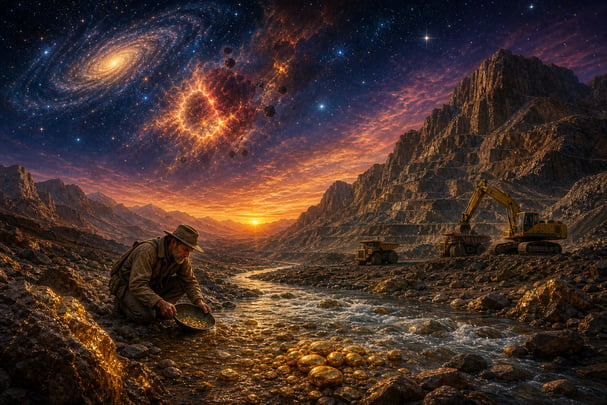
Gold has two very different origin stories. The first goes back billions of years, long before Earth existed, when gold was forged in some of the most violent events in the universe. The second is a lot closer to home, and it's about how gold gets out of the ground and into jewellery today, including the growing role that recycled gold plays in that supply.
Here's where it all actually comes from, from start to finish.
The cosmic origin of gold
Gold wasn't made on Earth. It was created in extreme cosmic events, including the explosive deaths of massive stars and the collisions of neutron stars, where intense heat and pressure forced atoms to fuse together into heavy elements, gold among them. These elements were scattered across space long before our solar system formed.
When Earth came together around 4.5 billion years ago, some of that gold was already part of the material that formed the planet. More arrived afterwards too, carried in by asteroid impacts during Earth's early history. Over time, geological processes concentrated that gold into deposits that could eventually be found and mined.
How gold ends up in the ground
Once gold was distributed through Earth's crust, natural processes worked to concentrate it into deposits worth mining. Two main types of deposit account for most of the gold found today:
- Hydrothermal deposits, where hot, mineral-rich water moving through cracks in rock deposited gold into veins over long periods of time
- Placer deposits, where weathering and erosion broke down gold-bearing rock, allowing rivers and streams to wash out lighter material and leave the denser gold behind in riverbeds and gravel
Placer deposits are what early prospectors searched for using pans and sluices, since the gold sat loose in sediment rather than locked inside hard rock.
How is gold actually mined today?
Modern gold mining uses several methods, often depending on the type of deposit involved:
- Underground (hard rock) mining, where shafts and tunnels are dug to reach gold-bearing rock deep below the surface
- Open-pit mining, used for deposits closer to the surface, where large amounts of rock are removed in stages to access the ore
- Placer or alluvial mining, which extracts gold from riverbeds and sediment rather than solid rock
- By-product recovery, where gold is extracted as a secondary output during the mining of other metals, such as copper
Once ore is extracted, it goes through crushing, chemical processing and refining to separate out the gold itself, a process that's far more involved than simply picking nuggets out of a stream.
Which countries produce the most gold?
A handful of countries account for most of the world's newly mined gold. China has consistently been the world's top gold-mining country, with output of around 380 metric tons in recent years, a position it's held for well over a decade. Russia typically follows close behind, with annual production estimated in the region of 310 to 315 metric tons, while Australia also regularly produces around 320 metric tons a year, putting the two in close competition for second and third place depending on the year.
Beyond the top three, Canada is generally the fourth-largest producer, extracting roughly 200 tonnes of gold annually, while the United States typically ranks fifth, with production around 158 tonnes. Together, these five countries make up a substantial share of all newly mined gold each year.
How much gold actually exists?
It's a surprisingly finite amount. The World Gold Council estimates that the total amount of gold ever mined throughout history comes to roughly 216,000 tonnes, and because gold doesn't corrode or break down, almost all of that is still in circulation in one form or another.
Of that total, jewellery accounts for the largest share, holding around 45% of all the gold that's ever been mined. The rest sits in investment bars and coins, central bank reserves, and other uses such as electronics and dentistry.
The other major source: recycled gold
Mining isn't the only source of gold entering the market each year. A meaningful share comes from recycling, and this side of the supply chain has been growing. Recycled gold made up around 28% of total global supply in 2025, and at least 90% of all recycled gold comes from old jewellery, with the remainder recovered from technology and electronics.
This is worth knowing if you've ever wondered what actually happens to gold jewellery once it's sold. Rather than disappearing, it's typically refined and reintroduced into the same global supply chain that newly mined gold feeds into, which is part of why gold remains so durable as a material and as a store of value.
What this means if you're holding onto old gold
Whether it came from a mine in China or a deposit in Canada decades ago, gold doesn't lose its properties over time. A worn chain, a broken ring or an old, unworn bracelet still contains exactly the same gold it always did, and that gold still has a place in the wider supply chain through recycling.
If you're sat on jewellery you no longer wear, our specialists assess each piece individually for its actual gold content, regardless of its age, condition or where it might have originally come from. Here's how the process works:
- You request a free postage pack or book a home collection
- Your items are sent to our team for in-house appraisal
- We provide one offer for your full collection within 7 to 14 days
- You have 60 days to decide whether to accept
- If you decline, your items are returned to you free of charge
With over 33,000 Trustpilot reviews, we aim to make the process as clear as possible from start to finish. If you've got questions about how items are assessed before an offer is made, our FAQs page covers many of the questions we're asked most often.
Gold has travelled a long way to end up in a jewellery box, whether through ancient mining, modern extraction or recycling along the way. If yours is sitting unused, requesting a free postage pack is a simple way to find out what it's worth today.