

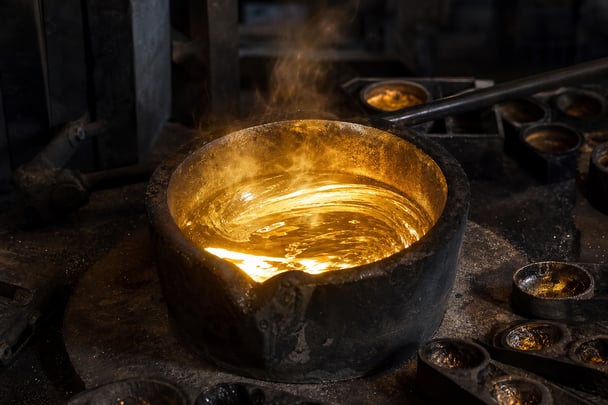
The phrase "liquid gold" gets used in a couple of quite different ways, and it's worth untangling both, since they're easy to mix up. Taken literally, it describes gold once it's heated past its melting point and becomes a free-flowing molten metal. Used more figuratively, particularly in financial circles, it refers to gold's reputation as one of the easiest physical assets to turn into cash.
Neither meaning has much to do with the other on the surface, but both point to qualities that make gold genuinely unusual as a material.
Molten gold: the literal version
Heat gold past roughly 1,064 degrees Celsius and it stops behaving like a solid altogether. Instead of bending or breaking, it flows, pours, and settles smoothly into whatever shape it's directed towards. Watching gold in this state, glowing and mirror-bright, is part of why refiners and jewellers describe the moment almost poetically, even though it's a straightforward physical change rather than anything mystical.
This liquid state isn't just a visual curiosity. It's the basis of how gold gets reshaped, purified and reused throughout its working life.
Why turning gold liquid actually matters
A few practical processes depend entirely on gold reaching this molten stage:
- Separating gold from other metals. When old or mixed jewellery is melted down, the liquid state allows refiners to draw the pure gold away from copper, silver or other alloy metals it's been combined with
- Casting new pieces. Jewellers pour molten gold into moulds to create new rings, chains and settings from scratch
- Repairing and resizing. Controlled, localised heating allows a jeweller to join or reshape gold without affecting the rest of a piece
None of this requires home equipment, since reaching and controlling these temperatures safely is squarely a job for trained professionals working with proper furnaces and ventilation.
Liquid gold as a way of describing an asset
Step away from chemistry and the phrase takes on a completely different meaning. In investing terms, "liquidity" describes how quickly and easily something can be converted into cash without losing much value along the way. Property, for instance, is famously illiquid, since selling a house can take months. Gold, by contrast, is often held up as an example of a highly liquid physical asset.
A few reasons why:
- It's recognised and traded almost everywhere, with a price that's tracked and published constantly
- It doesn't expire, spoil or need ongoing upkeep while you decide what to do with it
- It can be assessed and valued piece by piece, rather than needing a buyer for an entire collection at once
- Demand for it tends to hold up regardless of economic conditions, unlike many other physical goods
This is really the financial sense behind "liquid gold," and it's the reason gold has functioned as a fallback store of value for centuries, long before the phrase itself became common shorthand.
A smaller, more niche use of the term
Outside chemistry and finance, you might also come across "liquid gold" in pottery or ceramics circles, where it refers to a specialist gold-based solution painted onto plates, ornaments or glassware before firing, leaving a thin, permanent gold trim once the piece is heated. It's a genuine craft term, though it describes a decorative finish rather than the kind of gold most people end up selling.
Two meanings, one underlying thread
Whichever sense brought you here, both versions ultimately describe the same underlying material doing what it does best. Gold can be melted down and reshaped without ever stopping being gold, and it can be turned into cash with far less friction than most other things people own.
If you've got gold jewellery sitting unworn, whether it's old, broken, or simply not your style anymore, our team examines every item that arrives, weighing and testing it to work out exactly what it's made of before putting together one offer covering everything you've sent.
Getting started costs nothing and asks nothing of you upfront. Ask for a postage pack or arrange for someone to collect from your address, and once your items have been looked over, expect a single offer within seven to fourteen days. You'll then have up to sixty days to decide whether it suits you, and if it doesn't, everything is sent straight back at no charge.
Feedback from more than 33,000 customers on Trustpilot points to a process people generally find easy to follow from start to finish. You can browse the full range of items we look at, well beyond jewellery alone, on our What We Buy page.
Gold rarely sits still for long, whether it's being melted, traded or simply passed between owners. If yours has been gathering dust, requesting a postage pack costs nothing and commits you to nothing either.