

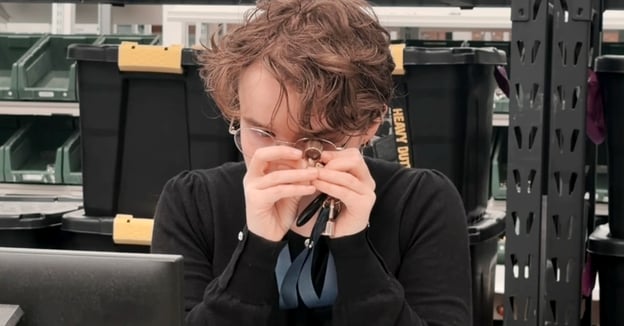
When we were small enough to count our staff and our boxes in the tens, training happened the way it has in specialist trades for generations: standing beside someone who already knew.
Experienced appraisers passed on the knowledge that can’t easily be found in a handbook: how to read a hallmark, spot a repair, recognise a maker’s mark and understand why two seemingly identical items can have completely different stories and completely different values.
That’s because appraising has never simply been about pricing an item.
It means understanding what something is, where it came from, how it was made, what condition it's in, and whether the evidence supports the story it appears to tell.
Sometimes the difference between an ordinary item and an extraordinary one is immediately obvious. But, more often, it's hidden in the details that only experience teaches you to notice.
As Vintage Cash Cow has grown to more than 800 employees across multiple European markets, we've had to think carefully about how we protect the quality and consistency of every appraisal. Growth should never come at the expense of trust. If customers are placing their belongings in our hands, they should have confidence that every item is assessed with the same care, expertise and attention to detail, whoever carries out the appraisal.
The Appraisal Academy was created to help us do exactly that: passing on the knowledge and standards we’ve built over the years while developing the next generation of Vintage Cash Cow appraisers.
Building expertise
We've been developing appraisers since the business began. The Appraisal Academy isn't a new approach; it's the next evolution of one that's already proven itself.
It brings together the knowledge, standards and ways of working we've refined over the years into a structured learning programme, giving every trainee the same foundations, while recognising that every item they assess will be different.
“I look for a conscientious interest in the items we see from the common everyday to the rarer and more special. A lot of our training materials and styles hinge on that interest in the narratives behind the objects, meaning that as trainers we take a very kinaesthetic approach to the training format which not only teaches the fundamentals of the role, but also serves as a journey through time.” Rufus McNiven, Appraisals Academy Manager
The Academy is our in-house training programme, designed to teach new appraisers how to value second-hand items accurately and consistently.
Every trainee follows a structured pathway through three learning levels, beginning with the fundamentals during probation before building expertise across categories including jewellery, watches and coins.
Training combines structured classroom learning with hands-on appraisal using our proprietary Appraisal Tool. Trainees experience guided practical exercises including identifying materials, applying authentication techniques, carrying out historical research, recognising condition and provenance, understanding resale demand and market pricing, and handling valuable items responsibly.
From day one, trainees work alongside experienced appraisers. They receive continuous feedback, learn when to seek a second opinion and gradually build confidence through real appraisal work. Like any specialist craft, much of the learning comes from observing experienced colleagues, discussing unusual finds and understanding how different pieces of evidence contribute to a final appraisal.
The aim isn’t to create appraisers who always have the answers. It's to develop the next generation of appraisers with the curiosity and judgement to know which questions to ask next.
Where technology fits
Technology is central to how we work, but not because it replaces expertise.
It removes unnecessary administration, brings together trusted information, allowing our teams to spend more time evaluating items and less time searching for information.
Every trainee learns the same foundations, works with the same tools and has access to the same trusted reference materials. That creates consistency in the process without pretending that every appraisal is the same.
Because it isn't.
No two boxes are ever identical. Every day brings unfamiliar objects, unexpected combinations and items that deserve a closer look. Technology can present the evidence more quickly, but it can't replace the experience needed to interpret it. An appraiser still has to decide what they're looking at, whether something is unusual, how its condition affects its value and whether the evidence supports the conclusion.
That's the balance we've deliberately built.
Molly Symms, Vintage Cash Cow’s Product Learning & Development Manager, talks about how she got into specialising in vintage and antique appraisal, and why it remains an enduring career.
“I have a BA in Classical Civilisation and I was often asked when studying why I chose this degree and what I was going to do with it. The answers I had at the time were: “I really like mythology” and “Hopefully something to do with museums”. But as I studied art, sculpture and numismatics I realised that alongside great heroes and impossible beasts, the draw to mythology was what these stories revealed about us, what we value, and what we perceive to be beautiful. The same can be said for appraising antiques. What pieces of the past have we carried through to today, and what has not endured? You see styles fall in and out of fashion, and can occasionally make educated guesses on what might be coming next. Real world events are expressed through the market - you can see what sells when the economy is strong, and what sells no matter what stocks, and oil, and gold are doing. A career in vintage & antique appraising is still relevant in today’s world as it doesn’t just allow you to build knowledge on what things are, it allows you to understand why things are.”
Looking ahead
Growth has always brought new opportunities, but also new responsibilities.
The ambition is to build a business that earns customers’ trust every day.
That means continuing to invest in technology that removes friction, refining the systems that support our teams and, above all, developing people with the curiosity, care and judgement to make good decisions.
Every day, our appraisers uncover remarkable stories hidden inside ordinary boxes. They help customers realise the value of items they no longer need and give those items the opportunity to be appreciated again.
As Vintage Cash Cow continues to grow, so will the Appraisal Academy. Training the next generation of appraisers is an investment not only in our people, but in the consistency and quality of every appraisal we carry out.
That's the business we're building.
One where technology makes expertise more efficient, not less human. Where knowledge is shared, curiosity is encouraged and experienced appraisers help develop those coming through behind them; Where people take pride in their craft, and customers benefit from a service that's efficient, trusted and personal.
For us, that's what building a business for the long term looks like.
Molly Symms, Vintage Cash Cow’s Product Learning & Development Manager
Collaborating with Rufus, Molly crafts the dynamic learning materials, classroom sessions, and fortnightly quizzes that keep our Appraisers sharp and well-informed. Drawing on a background in Classical Civilisation from Nottingham University, Molly brings a deep passion for the ancient world and the evolving meanings of its symbols to the academy. This unique historical insight helps our team decode the rich, layered stories behind the objects we appraise every day.
Rufus McNiven, Appraisals Academy Manager
With a BA, Classical Archaeology from UCL and an MA in Medieval Archaeology from the University of York, Rufus brings an investigative, cross-disciplinary approach to the Appraiser Academy. Drawing on history, archaeology and anthropology, he teaches trainees how to interpret material culture and uncover the stories objects tell, building the context needed to assess provenance, authenticity and value. His expertise, spanning thousands of years of material history, helps future appraisers develop the judgement and research skills required to make informed, evidence-based assessments.