

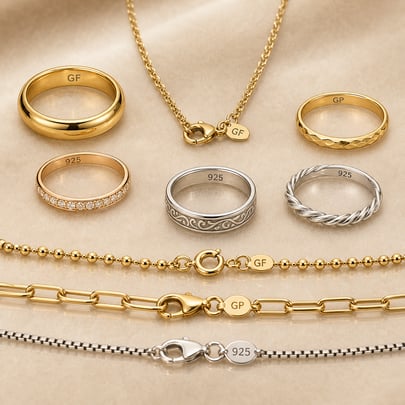
Sorting through old jewellery, you might turn over a piece and find a tiny mark stamped into the metal. A necklace clasp with GF. A ring marked GP. Or perhaps there’s just a number, like 925.
What do these actually mean?
These tiny stamps are a kind of shorthand. They tell us what a piece is made of and, more specifically, how much real gold it contains. Behind many of them are three common categories: gold filled, gold plated and gold vermeil. They can look almost identical, but they're made very differently, and the amount of gold in each varies considerably.
Here's the quick summary, from most gold to least:
- Solid gold: gold all the way through.
- Gold filled: has a substantial, bonded layer of real gold.
- Gold vermeil has a thinner layer of gold over sterling silver (925).
- Gold plated has the thinnest layer of all, over a cheaper metal.
Gold filled: a real layer of gold
Gold filled isn't plated, and despite the name, it isn't filled with gold either. The term refers to a manufacturing process that bonds a substantial layer of real gold to a base metal.
The result is a much thicker gold layer than you'd find on a plated piece. If gold plating is a coat of paint, gold filled is closer to a veneer: a genuine layer of gold attached to the surface rather than a thin coating. That extra thickness makes it far more durable, which is why many gold-filled pieces still look good decades after they were made.
The term originated in the United States, where gold filled jewellery must contain a gold layer equal to at least 5% of the item's total weight. Standards vary internationally, but that benchmark is still widely recognised across the trade.
You'll usually see gold filled marked as one of the following:
- GF, for gold filled
- 1/20 12K GF, meaning the gold layer is 1/20th of the total weight, and the gold itself is 12 carat
- RGP, or rolled gold plate, an older marking that uses the same bonding method but usually with less gold than a true gold filled piece
Vintage expert insight
“Because the gold is bonded rather than coated, gold filled wears far better than plating. We often handle pieces made in the 1950s and 60s that have kept their colour and finish, which is rare for anything plated.”
Gold plated: a fine coating
Gold plating is the thin gold coating most people picture when they imagine costume or fashion jewellery. A very fine film of gold is applied to the surface of a cheaper metal, usually by electroplating. That's a process where an electric current draws gold from a special solution and lays it evenly over the metal, leaving a fine gold skin on the surface. The result is a gold-coloured finish that looks attractive but contains relatively little gold.
In fact, that shiny, gold finish is frequently thinner than a human hair. Over time, it can wear through, especially on areas of frequent contact, such as ring bands, clasps and bracelet links.
Common markings include:
- GP (gold plated)
- HGE (heavy gold electroplate)
- Gold plated
HGE suggests a thicker coating than standard plating, but the term isn't tightly regulated and shouldn't be taken as a guarantee of value.
There's nothing wrong with gold plated jewellery. Plenty of attractive, well-made pieces are plated rather than solid or filled. There's simply much less of the gold itself.
Gold vermeil: gold over silver
Vermeil is a step up from ordinary plating, with two conditions attached. The base underneath has to be solid sterling silver, not a cheap base metal, and the gold layer has to be thicker than standard plating, usually at least 2.5 microns. So it's still a coating rather than solid gold, but a more generous one, over a more valuable base. It's common in modern jewellery, especially pieces from the last ten to fifteen years.
Vermeil doesn't have its own single letter-stamp the way gold filled (GF) and gold plated (GP) do. Because the base is sterling silver, you'll usually spot a 925 mark instead, sometimes alongside a gold mark. A 925 stamp on a piece that looks gold is often a sign you're holding vermeil.
So does any of this matter when you're deciding what to sell?
Up to a point.
Understanding the difference between gold filled, gold plated and vermeil can help you get a sense of what's in your jewellery box, but it won't tell you everything you need to know about value. A stamp can tell you what a piece is made from. It can't tell you whether it's rare, collectable or in demand.
A few things worth keeping in mind:
- Solid gold is commonly found in rings, chains, bracelets and other fine jewellery. Because the gold runs all the way through, these pieces are often valued for their weight and purity, though the maker, age and design can also play a part.
- Gold filled was widely used for jewellery, watches, spectacles and accessories throughout the twentieth century. It contains a meaningful layer of real gold and many older pieces remain attractive and collectable today.
- Gold plated is common in fashion jewellery, cufflinks, compacts, watches and decorative accessories. There's usually very little gold in the piece itself, but that doesn't mean it has no value. Some plated items are sought after because of their age, maker or design.
- Gold vermeil is often found in modern jewellery, particularly designer and boutique pieces. While it contains less gold than a gold-filled or solid gold item, some pieces can still be desirable in their own right, especially if they're well made or come from a recognised brand.
Vintage expert insight
A hallmark tells you what a piece is made from, not what it's worth. A gold-filled item from a respected maker may be worth more than its metal content alone, depending on factors such as rarity, production numbers, collectability, and current demand. That's why the hallmark is usually only part of the story.
Ready to find out what's in your jewellery box?
If you're going through an old jewellery box with a mix of pieces some of it may be hallmarked, some may have no markings at all and some may simply be too small to see with the naked eye.
The good news is that you don't need to work out what's worth sending and what isn't. Simply send everything together in one box (click here to find out what else we buy https://www.vintagecashcow.co.uk/items-we-buy) and our specialists will assess each piece individually before making a single fair offer for your collection.
And if the offer isn't right for you, we'll return everything free of charge.