

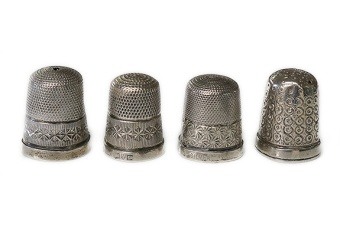
Turn over an old silver spoon, jewellery box or teapot and you'll often find a row of tiny symbols stamped into the metal.
It might be a walking lion. A leopard's head. An anchor. A castle. Or maybe a single letter inside a decorative shield.
What do they actually mean?
These tiny marks have been helping people identify precious metals for centuries. Together, they can tell you whether an item is sterling silver, where it was tested, who submitted it for hallmarking and, in many cases, when it was hallmarked.
If you've inherited silver, rediscovered a forgotten vase or are wondering if your old bangle is the real thing, then understanding these marks is one of the best places to begin.
And once you know what you're looking for, British hallmarks are surprisingly logical.
In this guide, we'll explain what each hallmark means, where to find them, how to tell sterling silver from silver plate, and why a hallmark is only one part of understanding an item's history and value.
Have silver you're looking to sell?
Whether it's a hallmarked teapot, jewellery box or a set of old cutlery, our experts will value it for free and make you a fair cash offer.
See what your silver could be worthWhat is a silver hallmark?
A hallmark is an official series of marks applied to an item made from precious metal after it has been independently tested by an Assay Office.
An assay is simply a test that confirms the purity of a precious metal.
For hundreds of years, independent Assay Offices have tested silver to make sure it meets recognised standards before it can legally be described and sold as precious metal. That's why hallmarking is often described as one of the oldest forms of consumer protection in the world.
Under the UK Hallmarking Act, silver items weighing 7.78g or less do not legally require a hallmark. Above this weight, hallmarking is mandatory before an item can be sold as silver, which prevents delicate pieces like small earrings or thin chains from being damaged by the hallmark punch, while keeping small silver goods affordable to produce.
A hallmark can help answer questions such as:
- Is this sterling silver?
- Is it solid silver or silver plate?
- Where was it hallmarked?
- Approximately when was it hallmarked?
- Who submitted it for hallmarking?
Did you know?
A hallmark isn't added by the silversmith. It's applied by an independent Assay Office after the metal has been tested to confirm it meets the required standard.
Where can I find silver hallmarks?
The hardest part is often finding the hallmark.
They're deliberately small and usually tucked somewhere discreet so they don't interrupt the design of the piece.
Here's where you'll most commonly find them:
|
Item |
Where you'll usually find the hallmark |
|
Spoons and forks |
Back of the handle |
|
Knives |
Collar or ferrule where the blade meets the handle |
|
Teapots and coffee pots |
Underside of the base |
|
Candlesticks |
Base or underside |
|
Napkin rings |
Inside the ring |
|
Jewellery |
Inside rings, on clasps or close to fastenings |
|
Boxes and cases |
Underside or inside the lid |
|
Picture frames |
Rear edge or supporting stand |
If you're having trouble reading them:
- Use daylight if possible.
- Look through a magnifying glass or use your phone's camera to zoom in.
- Shine a torch across the surface rather than directly at it. The low angle often makes worn marks stand out more clearly.
- Avoid vigorous polishing before you've examined the hallmark. Although normal careful polishing is fine, heavily worn antique marks can become more difficult to read over time.
.jpg?width=233&height=155&name=1854%20Birmingham%20Sterling%20Silver%20George%20Unite%202%20(1).jpg)
Understanding the different silver hallmarks
One reason hallmarking can seem confusing is that not every silver item carries exactly the same combination of marks.
Historic British silver often displays five traditional hallmark components, while many modern pieces carry fewer.
Today, newly hallmarked silver must include three compulsory marks: the sponsor's mark, the fineness mark and the Assay Office mark.
Many pieces also include a date letter, while older silver may carry a duty mark showing that tax had been paid.
If you're identifying antique or vintage silver, understanding all five will help you build a much clearer picture of what you're looking at.
|
Hallmark |
What it tells you |
|
Sponsor's mark |
Who submitted the item for hallmarking |
|
Standard (fineness) mark |
The purity of the silver |
|
Assay Office mark |
Where the item was tested and hallmarked |
|
Date letter |
The year the item was hallmarked (found on many pieces) |
|
Duty mark |
Historic tax mark found on pieces hallmarked between 1784 and 1890 |
Let's look at each one in turn.
1. The sponsor's mark
The sponsor's mark identifies the person or company that submitted an item for hallmarking.
It's usually made up of two or three initials inside a distinctive shield.
You'll often hear this called the maker's mark, and in many cases the sponsor and maker are the same. However, the mark technically identifies the registered sponsor rather than the individual craftsperson who physically made the piece.
For collectors and specialists, these initials can provide valuable clues.
Some British silversmiths became famous for their work, and recognising their registered marks can help identify where and when a piece was made. If you'd like to research a particular maker further, the Sheffield Assay Office maintains an archive of historic sponsor's marks and maker identification.
For most people, however, it's enough to know that this mark identifies the business responsible for presenting the item to the Assay Office.
2. The standard mark
The standard mark tells you the purity, or fineness, of the silver.
The vast majority of British silver you'll encounter is sterling silver, which contains 92.5% pure silver. The remaining 7.5% is made up of other metals, usually copper, added to improve strength and durability.
That's why you'll often see 925 stamped on silver jewellery and modern silverware.
Historic British sterling silver is also recognised by one of the country's most famous hallmark symbols, the Lion Passant.
Some British pieces display both the Lion Passant and the numerical 925 fineness mark. Others display only the millesimal fineness mark. Either way, both indicate sterling silver.
Once the purity of the silver has been confirmed, the item is hallmarked by one of the UK's Assay Offices.
The Assay Office mark tells you where that happened.
Unlike the sponsor's mark, which identifies the person or business responsible for submitting the piece, the Assay Office mark identifies the independent organisation that tested it.
Several Assay Offices have operated throughout British history. Today, four remain active:
|
Assay Office |
Hallmark |
Still operating? |
|
London |
Leopard's Head |
Yes |
|
Birmingham |
Anchor |
Yes |
|
Sheffield |
Rose (Crown before 1973) |
Yes |
|
Edinburgh |
Castle |
Yes |
Historic offices include:
|
Historic Assay Office |
Hallmark |
Closed |
|
Chester |
Three wheat sheaves and a sword |
1962 |
|
Exeter |
Castle |
1883 |
|
Glasgow |
Tree, fish and bell |
1964 |
|
Newcastle |
Three castles |
1884 |
|
York |
Half leopard's head and half fleur-de-lis |
1858 |
Although some historic Assay Offices have long since closed, you'll still come across their hallmarks on antique silver. Spotting one of these historic marks can be one of the first clues that a piece is considerably older than it first appears.
Did you know?
An item made by a Birmingham silversmith could, in some circumstances, be hallmarked in London. The Assay Office mark tells you where it was tested, not necessarily where it was manufactured.
Sterling silver or silver plate?
Our guide walks through the marks that tell the two apart, and what else affects how much a piece is worth.
Read the guide4. The date letter
If you've ever searched online for the age of a silver item, you've probably come across a confusing chart full of different fonts, upper and lower-case letters and oddly shaped shields.
That's because the British date letter system is more complicated than simply matching an "A" with a particular year.
Each Assay Office ran its own annual lettering sequence, and those sequences were repeated over time.
To tell one cycle from another, the letters changed style. The font, whether the letter was upper or lower case and the shape of the surrounding shield all became part of the code.
That means the same letter can represent different years depending on exactly how it appears.
For that reason, it's usually impossible to date a piece accurately from the letter alone. Instead, specialists read the date letter alongside the other hallmarks, particularly the Assay Office mark, before comparing it with official hallmark tables.
If you're simply trying to understand your silver, recognising that a date letter exists is often enough to know that the piece can usually be dated very accurately.
Did you know?
Date letters became optional in UK hallmarking in 1998, so many modern silver items won't include one.
5. The duty mark
If you're looking at Georgian or Victorian silver, you may notice something else among the hallmarks: a tiny portrait of a monarch.
This is known as the duty mark.
It was introduced in 1784, when the Government began charging duty on gold and silver. The mark showed that the tax had been paid.
The portrait changed as different monarchs came to the throne, so you'll see different heads depending on when the item was hallmarked.
Duty marks were abolished in 1890, so you'll only find them on silver hallmarked during that period.
They're no longer used today, but they remain an important part of identifying many antique British silver items.
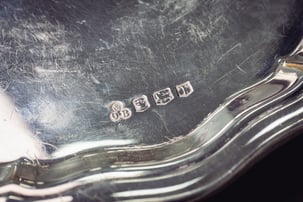
Why do some silver items have five marks while others only have three?
This is one of the questions we're asked most often.
British hallmarking has evolved over hundreds of years.
Older pieces often include:
- Sponsor's mark
- Standard mark
- Assay Office mark
- Date letter
- Duty mark
Modern pieces usually carry:
- Sponsor's mark
- Fineness mark
- Assay Office mark
Many modern items also include a date letter, although it is no longer compulsory.
So don't worry if your silver doesn't match a diagram you've found online. The number of marks often reflects when the item was hallmarked rather than whether it's genuine.
A hallmark tells you about the silver. It doesn't tell you the whole story.
Finding a hallmark is exciting, but it's only the beginning.
A hallmark confirms facts about the metal itself. It doesn't tell you whether the piece comes from a particularly desirable maker, whether it's an unusual design, whether collectors are actively looking for it or whether it has historical significance.
Take two silver teapots, both hallmarked in London in the exact same year. One might be worth its weight in silver, while the other, shaped with extraordinary detail or stamped by a celebrated silversmith could be worth very much more.
Specialists will look beyond the hallmark. They’re also always considering craftsmanship, rarity, condition, maker, age and today's market demand.
Understanding what you have often prompts a bigger clear-out. If you've decided it's time to part with your silver, why not gather together those other items you've been meaning to sort out too? We buy a wide variety of things, from jewellery and watches to coins, cameras and collectibles, so everything can go into the same sturdy box. We'll assess it all together and make one fair offer for the lot. Order your free Welcome Pack to find out more.
Relevant resources:
https://www.assayofficelondon.co.uk/hallmarking/what-is-a-hallmark
https://www.theassayoffice.co.uk/our-services/hallmarking/silver-assay-and-hallmarking/
https://www.assayoffice.co.uk/our-services/uk-hallmarks
https://www.edinburghassayoffice.co.uk/what-is-a-hallmark/

Our silver expert
Joanna Simpson
Silverware Expert at Vintage Cash Cow with over 10 years' experience in antiques and reselling, specialising in silver and silverware identification and valuation.