

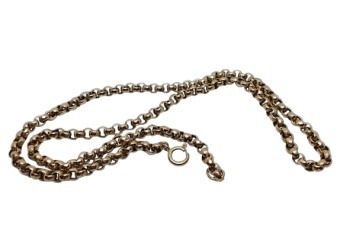
No, gold is not magnetic. In fact, pure gold is what's known as diamagnetic, this means it is very weakly repelled by a magnetic field rather than attracted to it. The effect is so faint that you won't notice anything with an ordinary household magnet.
If you hold a magnet near a piece of solid gold jewellery: nothing visible should happen at all.
That simple fact is also why a magnet has become a popular, low-cost way to get a first impression of whether jewellery might contain gold. It's a useful starting point, but it isn't the full picture, and it's worth understanding both why gold behaves this way and where the magnet test falls short.
Why isn't gold magnetic?
Magnetism, in the everyday sense most people picture, comes from metals like iron, nickel and cobalt. These are known as ferromagnetic materials.
Their atomic structure allows their electrons to line up in a way that creates a strong magnetic pull.
Gold's atomic structure doesn't work this way. Its electrons are arranged so that there's no overall magnetic alignment, which is why gold doesn't respond to magnets the way iron or steel does. This isn't unique to gold either. Other metals such as silver and copper behave in a similar way, which is part of why jewellery made from these metals also won't stick to a magnet.
Can you use a magnet to test gold?
A magnet test is a common first check, and it can be a helpful way to rule things out. Here's how it's usually done:
- Use a reasonably strong magnet, such as a rare-earth magnet, rather than a weak fridge magnet
- Hold the magnet close to the item without letting it touch
- Watch for any pull or movement towards the magnet
- If the item is drawn towards the magnet or sticks to it, it's unlikely to be solid gold
- If there's no reaction at all, the item could be gold, but this on its own doesn't confirm it
A noticeable pull is a useful warning sign. It usually means the item contains iron, steel or nickel somewhere in its structure, which gold simply doesn't.
Why a magnet test isn't enough on its own
This is where a lot of people get caught out. While a strong magnetic reaction is a fairly reliable sign that something isn't solid gold, the opposite isn't true. Plenty of materials used to imitate gold, such as brass, copper alloys and gold-plated base metals, are also non-magnetic. That means a fake or plated item can pass a magnet test just as easily as a genuine one.
In other words, a magnet test can help rule out some counterfeits, but it can't confirm that a piece is genuine gold. For that, a more thorough check is needed.
How a proper assessment works
When jewellery is properly assessed, specialists generally look at more than one indicator. This usually includes:
- Hallmark inspection, checking for stamps such as 375, 585, 750 or 999, which correspond to UK gold purities of 9ct, 14ct, 18ct and 24ct
- Acid testing, where a small amount of acid is applied to a discreet area to observe how the metal reacts
- XRF (X-ray fluorescence) testing, a non-destructive method that reads the metal's actual composition
Hallmarking in the UK is overseen by the Assay Offices, and a genuine hallmark is one of the clearest signs of an item's purity, though older or worn pieces don't always have a clear, legible mark. That's why a mix of methods is often used together rather than relying on just one.
What this means for old or unmarked jewellery
If you're sorting through inherited jewellery or an old collection, it's common to find pieces with no visible hallmark, a worn stamp, or a mix of items you're simply unsure about. A magnet test might tell you that something is worth a closer look, but it won't give you a definite answer either way.
This applies just as much to damaged or odd items. A bent ring, a single earring or a tangled chain can still be made of solid gold even if it looks a little worse for wear, and weight, purity and condition are usually assessed together rather than ruling anything out on appearance alone.
How this works if you're selling jewellery
Rather than relying on a quick test, our specialists assess every item individually using proper testing methods, including hallmark checks, acid testing and XRF analysis where appropriate.
Postage is insured as standard, and higher levels of cover are available if you're sending a larger or more valuable collection. With over 500,000 customers and a long track record on Trustpilot, the process is built around giving every item a fair, considered look rather than a quick guess.
If you'd like to understand more about how items are checked before an offer is made, our FAQs page covers some of the most common questions we're asked. And if you've got a mix of jewellery you're unsure about, whether magnetic, marked or completely unidentified, booking a home collection is a simple way to find out what you've actually got.